
Best eSIM for Japan Travel in 2026
How to choose a Japan eSIM: which network suits your route, how much data you need, validity, and when pocket Wi-Fi is the better option.
Quick answer
- Any major network works well in Japan's cities; the network matters most in rural areas and the mountains.
- Japan trips use data steadily for maps, transport and translation, so size your plan for your busiest days.
- For families who stay together, compare one pocket Wi-Fi with an eSIM for each person.
- Install at home, and screenshot your Visit Japan Web QR codes before you fly.
Japan has some of the best mobile coverage in the world, which makes choosing an eSIM less about finding signal and more about picking the right plan: which network, how much data and how many days. Get those three right and your phone will handle train transfers, translation and maps without a second thought.
This guide focuses on choosing the best eSIM for Japan. If you're still deciding between an eSIM, pocket Wi-Fi and roaming, our eSIM Japan guide compares all four options in detail.
The Short Answer
For most visitors, the best eSIM for Japan is a data plan on one of the major Japanese networks, with enough data for your trip and a validity that starts when you arrive. If you're traveling with several people who'll stay together all day, compare the total cost with a shared pocket Wi-Fi; for everyone else, an eSIM each is usually simpler.
Japan eSIM Plans at a Glance
Japan eSIM plans on Data Roaming
Live prices in US dollars
1 GB · 7 days
NTT docomo, Rakuten Mobile
3 GB · 30 days
NTT docomo, Rakuten Mobile
5 GB · 30 days
NTT docomo, Rakuten Mobile
10 GB · 30 days
NTT docomo, Rakuten Mobile
20 GB · 30 days
NTT docomo, Rakuten Mobile
50 GB · 30 days
NTT docomo, Rakuten Mobile
| Data | Validity | Network | Price | Buy |
|---|---|---|---|---|
| 1 GB | 7 days | NTT docomo, Rakuten Mobile | $1.40 | Buy |
| 3 GB | 30 days | NTT docomo, Rakuten Mobile | $3.60 | Buy |
| 5 GB | 30 days | NTT docomo, Rakuten Mobile | $5.40 | Buy |
| 10 GB | 30 days | NTT docomo, Rakuten Mobile | $9.40 | Buy |
| 20 GB | 30 days | NTT docomo, Rakuten Mobile | $16.40 | Buy |
| 50 GB | 30 days | NTT docomo, Rakuten Mobile | $34.00 | Buy |
Prices come from our live catalogue and update automatically. Every plan shown allows hotspot use.
See all 23 plansAt the time of writing, our Japan plans connect through NTT Docomo, KDDI (au), SoftBank or Rakuten Mobile, depending on the plan. Each plan lists its network before you buy.
How to Choose the Best Japan eSIM
Pick the network that fits your itinerary
Japan's four networks all cover the big cities well, so for a Tokyo, Kyoto and Osaka trip the network matters less than you might think. It matters more in the countryside: mountain villages, hiking trails and smaller islands can have signal on one network and little on another. If you're heading somewhere remote, check which network a plan uses and look at that operator's coverage map. Rakuten Mobile is the newest of the four, so its own network is less established in some rural areas.
Size your data for maps and translation
A Japan trip leans on data in small, constant ways: checking train routes, translating menus with your camera, looking up opening hours and pulling up QR codes. None of these is heavy on its own, but they add up over a long day. Video calls and streaming are what really use data, so plan for those separately.
Match validity to your dates
Our Japan plans run from a week to several months. Choose one that covers your whole stay, and check whether it starts counting days when you install it or when it first connects in Japan.
Check hotspot and phone number needs
Every plan in the table above allows hotspot use, which helps if you're sharing with a laptop or tablet. Like most travel eSIMs, they're data-only, so they don't include a Japanese phone number. If you need one for a specific booking, ask your hotel to help or look for a booking option that accepts an international number.
Coverage Beyond the Cities

In cities, coverage is excellent, including in most subway stations. On the Shinkansen, data is usually workable, with brief drops in long tunnels. The places to plan for are mountain areas such as the Japanese Alps, rural parts of Hokkaido and Kyushu, smaller islands and long hiking routes.
If your trip includes any of those, two habits help: download offline maps for the area before you go, and save offline language packs in your translation app so you can still read signs and menus without signal.
How Much Data Do You Need in Japan?
The best estimate comes from your own usage. Check how much mobile data you use in a typical week at home, divide by seven, and add a little for the extra navigation and translation you'll do in Japan.
As a worked example, if you average around 700MB a day, a 10-day trip comes to about 7GB. Add a buffer for days with video calls or heavy photo sharing, and a 10GB plan gives you comfortable room. To make your data last:
- Back up photos on hotel Wi-Fi rather than mobile data.
- Download offline maps for each city before you arrive.
- Keep streaming for Wi-Fi, especially on long train journeys.
eSIM vs Pocket Wi-Fi vs Roaming
An eSIM suits solo travelers and couples with recent unlocked phones: nothing to collect or return, and data as soon as you land.
Pocket Wi-Fi suits families and groups who stay together, since one router can connect several devices. It's another device to charge, and everyone needs to stay in range.
Roaming with your home carrier is the least effort, but daily rates to Japan can be high. Check the price and any data limits before you rely on it.
The eSIM Japan guide covers these options, local SIM cards and the full setup process in more detail.
Setting Up Your Japan eSIM
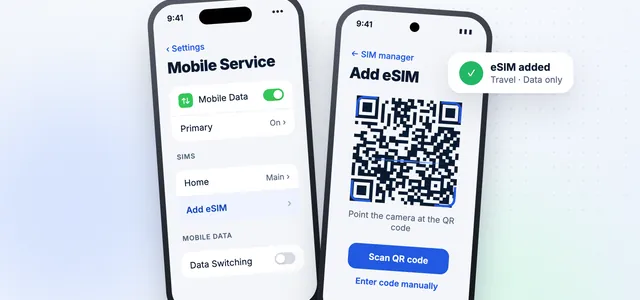
- Check that your phone supports eSIM and is unlocked.
- Buy a plan that covers your whole stay.
- Install it at home on Wi-Fi a day or two before you fly.
- When you land at Narita, Haneda, Kansai or any other airport, switch the eSIM on, set it as your mobile data line and turn on data roaming for that line.
- Keep data roaming off on your home SIM.
Screenshot your Visit Japan Web QR codes
If you've registered with Visit Japan Web for immigration and customs, save screenshots of your QR codes before the flight so they're on your phone even if your connection takes a moment to start.
Our step-by-step guide shows how to install an eSIM on iPhone and Android.
Tips for Staying Connected in Japan
- Use LINE for local contacts. It's the most widely used messaging app in Japan and works over any data connection.
- Treat free Wi-Fi as a backup. You'll find it in many stations, convenience stores and hotels, but sign-ups and reliability vary.
- Carry a power bank. Navigation and camera translation drain batteries quickly.
- Install a safety app. The Safety tips app, backed by the Japan Tourism Agency, sends earthquake and weather alerts in several languages over your data connection.
Frequently asked questions
Which network is best for an eSIM in Japan?
All four major networks cover the cities well. For remote areas, Docomo is often described as having the widest coverage, but check the coverage map for the places you'll visit.
Is a Japan eSIM better than pocket Wi-Fi?
For solo travelers and couples, an eSIM is usually simpler. For groups who stay together, a pocket Wi-Fi can cost less overall. Compare the total for your group.
Do Japan eSIMs include a phone number?
Most, including ours, are data-only. Use messaging apps for calls, and ask your hotel for help with bookings that need a Japanese number.
Will my eSIM work in Hokkaido and Okinawa?
Yes, they're part of Japan and covered by Japanese networks. Coverage in remote parts of Hokkaido can be patchier, so download offline maps.
How much data do I need for a week in Japan?
At around 700MB a day, a week uses about 5GB. Video calls and streaming push that up, so leave a buffer.
Next step
See Japan eSIM plans
Compare plans by network, data and validity.
See Japan eSIM plansData Roaming Editorial Team
We write practical, plain-English guides about using your phone abroad. Roaming prices and rules change, so we update guides regularly — always confirm current terms with your carrier. About our editorial approach


 Japan
Japan South Korea
 Asia & Oceania
 Thailand
 USA eSIM
 France eSIM
 Spain eSIM
 Italy eSIM
 Dubai eSIM
 UK eSIM
 Turkey eSIM