
EU Roaming Rules Explained: What "Roam Like at Home" Really Covers
Where Roam Like at Home applies, what it covers, the fair-use, long-stay and at-sea limits, and when a travel eSIM still makes sense for trips in Europe.
Quick answer
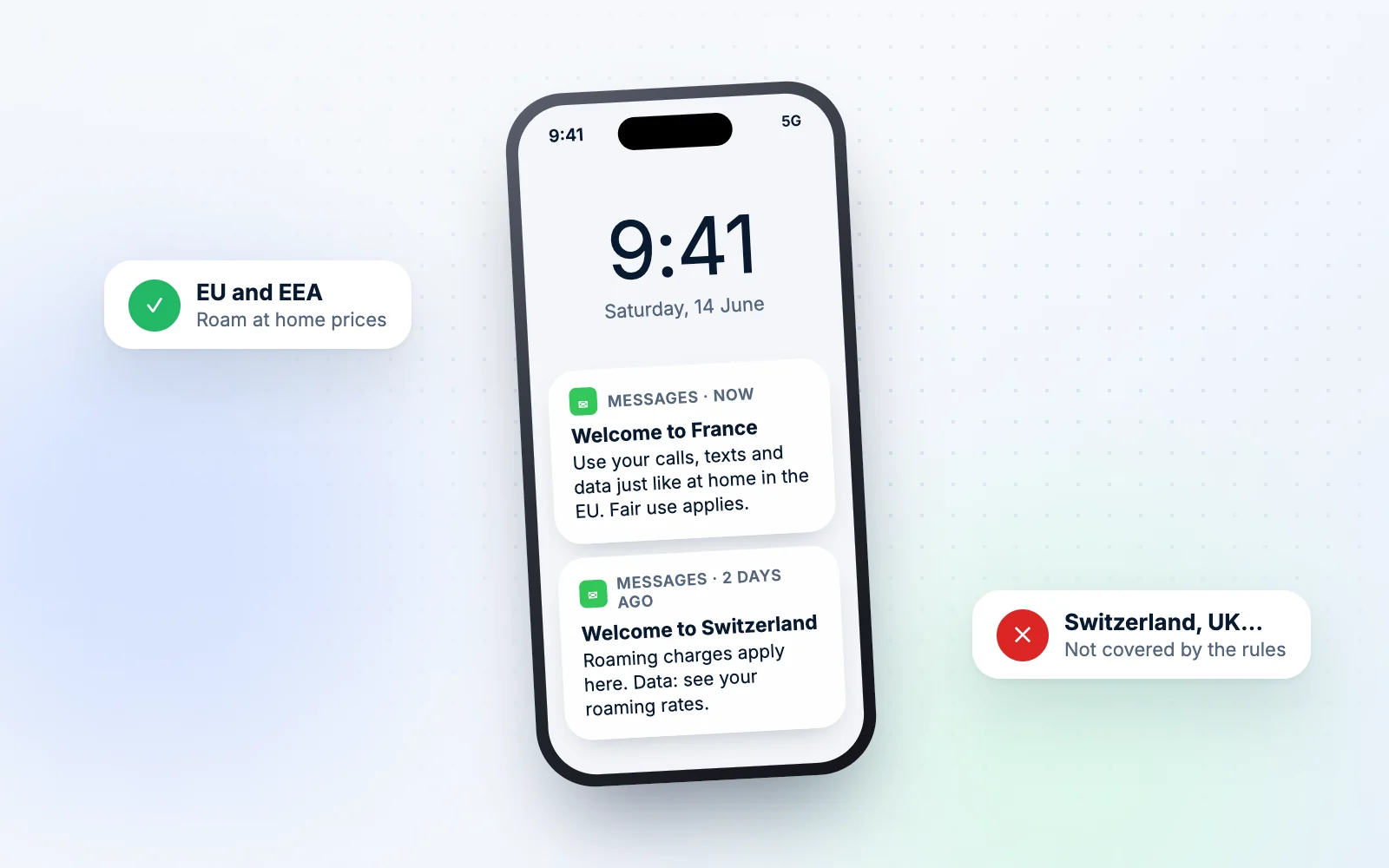
- With an EU or EEA SIM, calls, texts and data cost the same across the EU, Iceland, Liechtenstein and Norway.
- The UK, Switzerland, Turkey and the Western Balkans aren't covered by the rules.
- Cheap and unlimited plans can have a fair-use limit, and long stays abroad can lead to surcharges.
- Ships, planes and SIMs from outside the EU and EEA aren't protected by the rules.
If your SIM is from a European Union country, you can usually use your phone across the EU without paying extra, thanks to the EU roaming rules known as "Roam Like at Home". But those rules have limits that regularly catch travelers out: not every European country is included, cheap and unlimited plans come with a fair-use limit, and nothing protects you at sea or in the air.
This guide explains the EU roaming rules in plain language: where they apply, what they cover, the limits to know about, and when a travel eSIM still makes sense.
The Short Answer
With a SIM from an operator in the EU, Iceland, Liechtenstein or Norway, you can use your plan's calls, texts and data in any of those countries at no extra charge, within your operator's fair-use limits.
The rules don't cover the UK, Switzerland, Turkey or the Western Balkans, and they don't help travelers whose SIM comes from outside the EU and EEA.
What Is Roam Like at Home?
Since June 2017, EU rules have stopped operators from adding roaming charges when their customers travel within the EU and the wider European Economic Area (EEA). Your plan works abroad as it does at home: the same minutes, texts and data, at the same price.
The rules were renewed in 2022 and now run until 2032. The renewal also added a requirement for the same quality of service abroad where the network allows it, so if you have 4G or 5G at home and the network you roam on offers it, you should get it too.
Where the EU Roaming Rules Apply
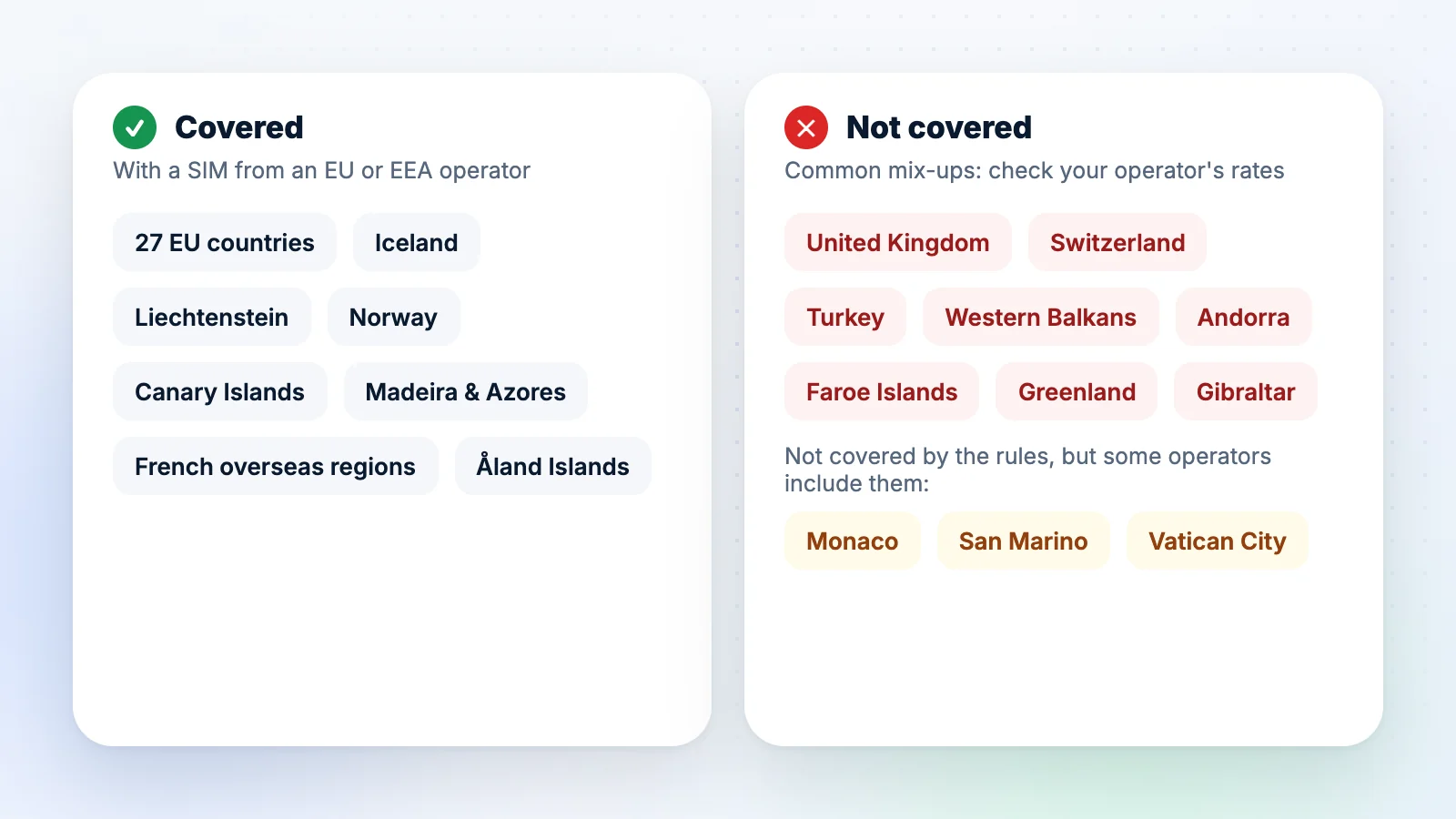
Covered: all 27 EU countries plus Iceland, Liechtenstein and Norway. That includes EU regions far from mainland Europe, such as the Canary Islands, Madeira and the Azores, the French overseas regions in the Caribbean, South America and the Indian Ocean, and the Åland Islands.
Not covered by the rules:
- The United Kingdom, since Brexit took effect in 2021. Our UK eSIM guide explains what that means for visitors.
- Switzerland, which isn't part of the EU or the EEA.
- Turkey and the Western Balkans: Albania, Bosnia and Herzegovina, Kosovo, Montenegro, North Macedonia and Serbia.
- Andorra, the Faroe Islands, Greenland and Gibraltar.
- Monaco, San Marino and Vatican City, although many operators include them anyway.
Some operators also include countries like the UK or Switzerland in their own bundles. That's a choice by your operator, not a right under the rules, so check your plan before you go.
What Roam Like at Home Covers
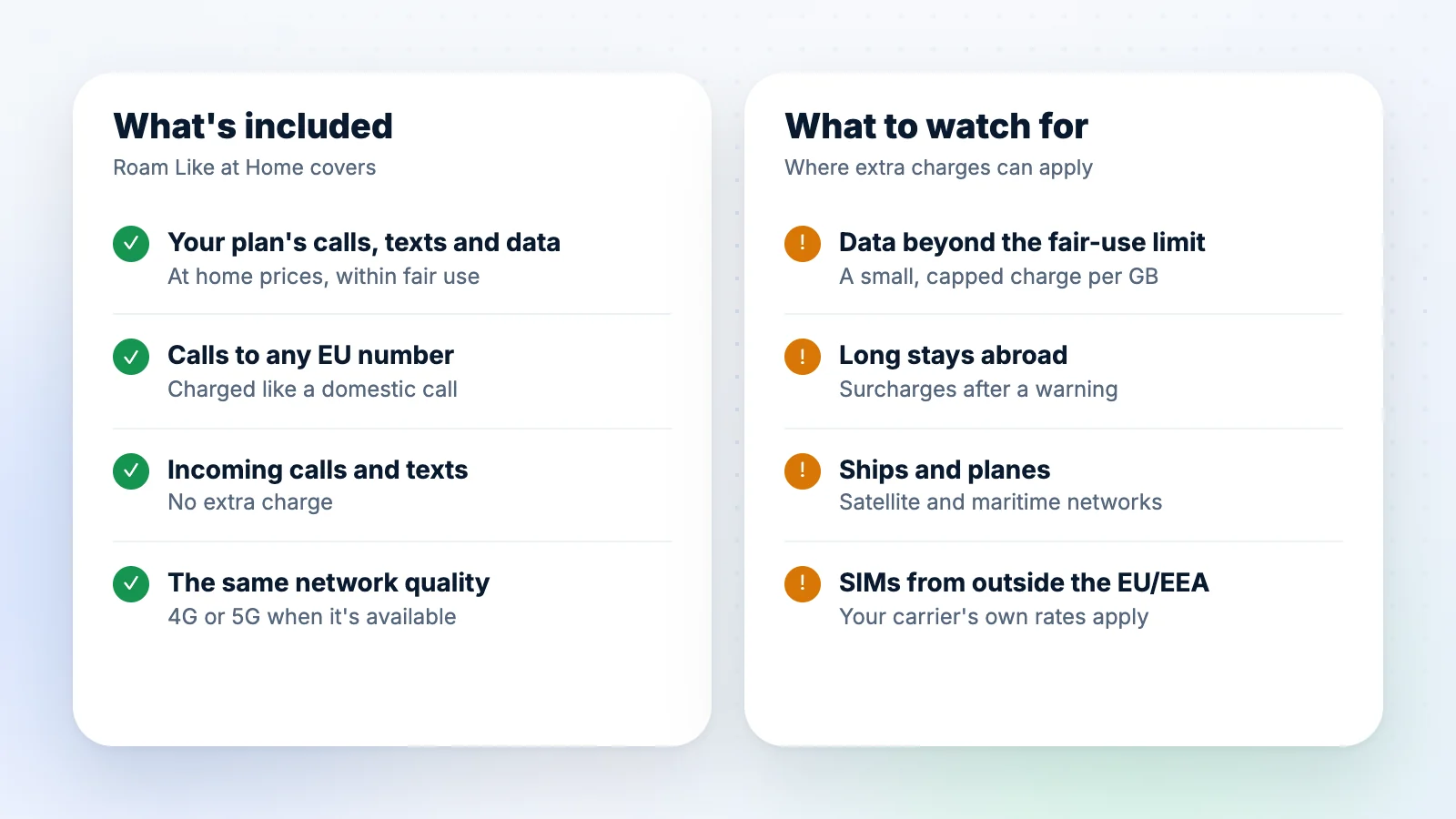
- Your plan's calls, texts and data, at home prices, within fair use.
- Calls and texts to any EU or EEA number while you're roaming, charged like a domestic call.
- Incoming calls and texts, at no extra charge.
- The same network quality you'd get at home, where the visited network offers it.
- The emergency number 112, free from any phone.
The Limits to Know About
Fair use on data
If you have a cheap plan or unlimited data, your operator can set a fair-use limit on how much data you can use while roaming at home prices. The limit is worked out with a formula set in EU rules, based on the price of your plan, and your operator has to tell you what it is, often in the welcome text you get when you arrive or on its website.
If you go over the limit, your operator can add a small charge per gigabyte. That charge is capped by EU law, and the cap falls each year until 2027.
Long stays abroad
Roam Like at Home is meant for travel, not for living abroad on a foreign SIM. If, over four months, you spend more time abroad than at home and use more abroad than at home, your operator can warn you. If nothing changes within 14 days of the warning, it can start adding surcharges.
Ships, planes and satellite networks
On ferries, cruise ships and planes, your phone may connect to a maritime or satellite network. These aren't covered by Roam Like at Home and can be very expensive. Switch on airplane mode, or turn off data roaming, unless you've checked the price. Your operator has to warn you when you connect to one of these networks.
Calls from home to another EU country
Roam Like at Home is about using your phone while you're abroad. Calling or texting another EU country from home is a separate matter, with its own EU price cap. Many plans include those calls anyway.
Special numbers
Calls to customer-service lines, premium numbers and some other special numbers can cost more while you're roaming than at home. Check before you call one abroad. Our guide to data roaming charges covers what else can add to a bill.
Who the Rules Don't Help
The EU roaming rules only protect customers of operators in the EU and EEA. They don't apply if:
- Your SIM is from outside the EU and EEA, for example from the US, the UK, Switzerland or Morocco. Your carrier's own roaming rates apply, even inside the EU.
- You're an EU resident visiting a non-EU country, such as the UK, Switzerland, Turkey or Morocco. Your operator decides what to charge there.
Our roaming calculator checks whether both your home country and your destination are in the EU or EEA, and estimates what roaming would cost if they're not.
When a Travel eSIM Still Makes Sense
For EU residents traveling within the EU, Roam Like at Home is often all you need. A travel eSIM is still worth considering when:
- Your trip includes countries outside the rules, such as Switzerland, the UK or the Balkans. A Europe plan that lists every country on your route avoids per-country charges. Our guide to the best eSIM for Europe explains how to choose one.
- Your fair-use limit is too small for the data you'll use.
- You're staying for months, when the long-stay rules could apply.
- Your SIM is from outside the EU and EEA, so the rules don't help you at all.

Quick Checklist Before You Travel in Europe
- Check that every country on your route is in the EU or EEA, and look up your operator's rates for any that aren't.
- Find your fair-use limit, especially if you have a cheap or unlimited plan.
- Switch on airplane mode on ferries, cruise ships and planes.
- If your SIM is from outside the EU and EEA, compare your carrier's roaming rates with a travel eSIM before you go.
Frequently asked questions
Is roaming free in the EU?
For customers of operators in the EU and EEA, yes: you can use your plan's calls, texts and data across the EU, Iceland, Liechtenstein and Norway at no extra charge, within fair-use limits.
Does EU roaming cover the UK?
No. Since Brexit took effect in 2021, the UK is outside the EU roaming rules. Some operators still include it in their plans, but that's their choice.
Does EU roaming cover Switzerland?
No. Switzerland isn't part of the EU or the EEA, so operators can charge for roaming there. Check your operator's rates before you go.
How long do the EU roaming rules last?
The current rules were renewed in 2022 and run until 2032.
What is the fair-use limit for EU roaming?
It depends on your plan. Operators can set a limit on data for cheap and unlimited plans using a formula in EU rules, and they must tell you what it is. Above it, they can add a small charge per gigabyte, capped by EU law.
Next step
Check your roaming costs
See if roaming is included for your trip, and what it would cost if not.
Check your roaming costsData Roaming Editorial Team
We write practical, plain-English guides about using your phone abroad. Roaming prices and rules change, so we update guides regularly — always confirm current terms with your carrier. About our editorial approach




 Europe
 France
 Spain
 UK
 USA eSIM
 Japan eSIM
 Italy eSIM
 Dubai eSIM
 Turkey eSIM