
Best eSIM for Europe Travel in 2026
How to choose a Europe eSIM: regional plans, which countries to double-check, how much data you need and how to set it up before your trip.

Quick answer
- A regional plan that lists every country on your route is the best fit for most multi-country trips.
- Check non-EU countries such as the UK, Switzerland, Turkey and the Balkans: not every Europe plan includes them.
- Size your data from your own daily use, and add a buffer for long train days and video calls.
- Install at home on Wi-Fi; one eSIM works across borders without reinstalling.
Europe is one of the easiest places in the world to stay connected, but it's also where travelers most often overpay. Crossing three borders in a week can mean three different roaming rates, and the EU's "roam like at home" rules only help if your SIM comes from an EU country. A good Europe eSIM gives you one plan that works across the whole trip.
This guide explains what the best eSIM for Europe looks like in practice: how regional plans work, which countries to double-check, how much data you're likely to need and how to set everything up before you fly.
The Short Answer
For most trips, the best eSIM for Europe is a regional plan that lists every country on your route, with enough data for your whole stay and a validity that starts when you first connect. If you're only visiting one country, a single-country plan can be cheaper; if you're hopping between several, one regional plan saves you buying a new SIM at every border.
Check the country list, not just the name
"Europe" means different things to different plans. Some include the UK, Switzerland, Turkey or the Balkans, and some don't. Read the list before you buy.
Europe eSIM Plans at a Glance
Europe eSIM plans on Data Roaming
Live prices in US dollars
1 GB · 30 days
34 countries
3 GB · 30 days
41 countries
5 GB · 30 days
41 countries
20 GB · 30 days
41 countries
50 GB · 30 days
34 countries
100 GB · 180 days
35 countries
| Data | Validity | Countries | Price | Buy |
|---|---|---|---|---|
| 1 GB | 30 days | 34 countries | $3.00 | Buy |
| 3 GB | 30 days | 41 countries | $14.60 | Buy |
| 5 GB | 30 days | 41 countries | $22.00 | Buy |
| 20 GB | 30 days | 41 countries | $64.00 | Buy |
| 50 GB | 30 days | 34 countries | $68.00 | Buy |
| 100 GB | 180 days | 35 countries | $136.66 | Buy |
Prices come from our live catalogue and update automatically. Every plan shown allows hotspot use.
See all 57 plansMost of our Europe plans cover 30 or more countries, and a few smaller plans cover a handful of neighbors. Each plan connects to local partner networks in every country it lists, and the network names are shown on each plan.
What Makes an eSIM Good for Europe
Every country on your route
This is the deciding factor. EU countries are almost always included, but the edges of the map vary. Among our current Europe plans, most include the UK, Switzerland, Norway and Iceland, fewer include Turkey or Serbia, and none cover Andorra or Monaco. If your trip touches any of these, choose a plan that lists them.
Enough data for the whole trip
Regional plans range from a few gigabytes for a short city break to large allowances for longer trips. Running out halfway through usually means buying a top-up or a second plan, so it's worth sizing up rather than down.
Validity that matches your dates
Check two things: how many days the plan lasts, and when those days start. Some plans start counting when the eSIM first connects in Europe, others when you install it. For a long trip, a plan that starts on first connection lets you install it at home without wasting days.
Hotspot and network speed
If you'll share data with a laptop or a travel companion, make sure hotspot use is allowed. Every plan in the table above allows it. 4G is plenty for maps, messaging and browsing; 5G is a bonus where it's available.
Coverage Across Europe

Mobile coverage in European cities is generally excellent, and most countries have good coverage along main roads and rail lines. Gaps are more likely in mountain areas, on remote islands and in parts of Scandinavia's far north.
When you cross a border, your phone switches to a partner network in the next country on its own. You may notice a short drop in signal at the border itself, especially on trains. If data doesn't come back after a few minutes, toggling airplane mode on and off usually fixes it.
At sea, ferries and cruise ships often switch to their own maritime networks, which aren't covered by travel eSIMs and can be expensive. Turn off mobile data or use airplane mode while you're out of range of land, and use the ship's Wi-Fi if you need to get online.
How Much Data Do You Need in Europe?
The most reliable estimate comes from your own phone. Check your mobile data use for a typical week at home, divide by seven, and adjust for travel: more maps and translation, perhaps less streaming if you're out all day.
As a worked example, a traveler using around 700MB a day on a two-week rail trip needs roughly 10GB, plus a buffer for the days with long train journeys or video calls home. A few habits help:
- Download offline maps for each city before you arrive.
- Set photo backups to Wi-Fi only and let them run at your hotel.
- Keep streaming for Wi-Fi, especially on long train rides where signal can come and go.
eSIM vs Roaming vs a Local SIM in Europe
Roaming with your home carrier can be free if you have an EU or EEA SIM, thanks to the EU's roaming rules, though fair-use limits still apply. Travelers with SIMs from elsewhere, including many UK plans since Brexit, usually pay daily or per-megabyte roaming fees. Check your carrier's rates before you rely on them; our guide to data roaming charges explains how they work.
A local SIM card can be good value if you're staying in one country for a long time. On a multi-country trip, though, you'd be relying on that country's EU roaming allowance, and buying one often means finding a shop and, in some countries, showing ID.
A regional travel eSIM suits most multi-country trips: one plan, set up before you leave, with your home SIM still in place for calls and texts.
Setting Up Your Europe eSIM
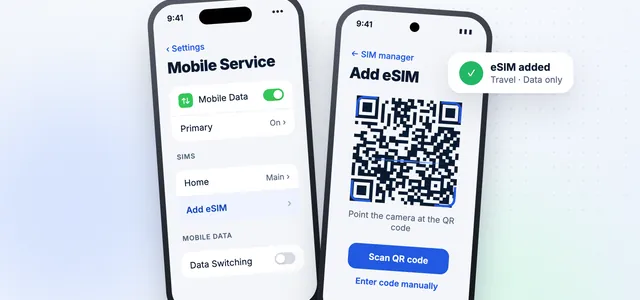
- Check that your phone supports eSIM and is unlocked.
- Buy a plan that lists every country on your route.
- Install it at home on Wi-Fi, a day or two before you fly.
- When you land, switch the eSIM on, set it as your mobile data line and turn on data roaming for that line.
- Keep data roaming off on your home SIM so it can't use data abroad.
Don't delete the eSIM between countries
One eSIM covers your whole trip. If data stops after a border, restart your phone rather than removing the eSIM: many can only be installed once.
Our step-by-step guide shows how to install an eSIM on iPhone and Android.
Tips for Staying Connected in Europe
- Check borders on your route. If you're crossing into a non-EU country such as Switzerland, Serbia or the UK, confirm it's on your plan.
- Expect brief drops on trains. Tunnels and border crossings can interrupt data for a few minutes.
- Watch out at sea. Switch off mobile data on ferries and cruises unless your plan clearly covers maritime networks.
- Keep your home number reachable. With a dual-SIM phone, your regular SIM can stay on for calls and texts while the eSIM handles data.
Frequently asked questions
Does one eSIM work in every European country?
Only in the countries its plan lists. Most Europe plans cover the EU and several neighbors, but non-EU countries such as the UK, Switzerland, Turkey or the Balkans vary from plan to plan, so check the list.
Do I need an eSIM if I have an EU SIM card?
Maybe not. EU and EEA SIMs can usually roam within the EU at home rates, subject to fair-use limits. An eSIM still helps if you're visiting non-EU countries or need more data than your plan allows abroad.
Does a Europe eSIM work in the UK?
Many do, but not all. At the time of writing, most of our Europe plans include the UK. Check the country list on the plan before you buy.
Will my eSIM work on trains between countries?
Yes. Your phone switches to a partner network when you cross a border. Expect brief drops in tunnels and at the border itself.
Can I use a Europe eSIM on a cruise or ferry?
Only while you're in range of land networks in countries your plan covers. At sea, ships often use their own maritime networks, which travel eSIMs don't cover, so switch off mobile data.
Next step
See Europe eSIM plans
Compare regional plans by country list, data and validity.
See Europe eSIM plansData Roaming Editorial Team
We write practical, plain-English guides about using your phone abroad. Roaming prices and rules change, so we update guides regularly — always confirm current terms with your carrier. About our editorial approach



 France
 Spain
Spain Italy
Italy Germany
 USA eSIM
 Japan eSIM
 Dubai eSIM
 UK eSIM
 Turkey eSIM