
Best eSIM for France Travel in 2026
How to choose a France eSIM: networks, coverage from Paris to the Alps, EU roaming, Monaco and the overseas departments, data needs and setup.

Quick answer
- Choose a plan on a major French network; all four cover Paris and the big cities well.
- EU and EEA SIMs can usually roam in France at home rates; other travelers usually pay extra.
- Monaco and the overseas departments aren't covered by most France plans.
- Visiting other countries too? A Europe plan covers the whole route with one eSIM.
France is one of the most visited countries in the world, and most trips lean on a phone: navigating the Paris Métro, booking museum slots, finding a bakery in a Provence village or checking train times on the TGV. If your SIM comes from an EU country, roaming is probably covered. If it doesn't, a travel eSIM is usually the easier and cheaper way to stay online.
This guide explains what makes the best eSIM for France: which networks to look for, how coverage varies between Paris and the countryside, what to know about Monaco and the overseas departments, how much data you'll need and how to set everything up before you fly.
The Short Answer
For a trip to France alone, the best eSIM is a data plan on a major French network, with enough data for your stay and a validity that starts when you arrive. If France is one stop on a longer European trip, a regional Europe plan is usually simpler than buying separate country plans.
France eSIM Plans at a Glance
France eSIM plans on Data Roaming
Live prices in US dollars
1 GB · 7 days
Orange
3 GB · 30 days
Orange
5 GB · 30 days
Orange
10 GB · 30 days
Orange
20 GB · 30 days
Orange
50 GB · 30 days
Orange
| Data | Validity | Network | Price | Buy |
|---|---|---|---|---|
| 1 GB | 7 days | Orange | $1.40 | Buy |
| 3 GB | 30 days | Orange | $3.60 | Buy |
| 5 GB | 30 days | Orange | $5.40 | Buy |
| 10 GB | 30 days | Orange | $9.40 | Buy |
| 20 GB | 30 days | Orange | $16.40 | Buy |
| 50 GB | 30 days | Orange | $34.00 | Buy |
Prices come from our live catalogue and update automatically. Every plan shown allows hotspot use.
See all 9 plansAt the time of writing, our France plans connect through Orange, France's largest mobile network. Each plan lists its network, data and validity before you buy.
What Makes an eSIM Good for France
A major French network
France has four main mobile networks: Orange, SFR, Bouygues Telecom and Free Mobile. All four cover Paris and the other big cities well. Orange's coverage is often described as one of the most extensive, which matters most in rural areas and mountain regions.
Enough data for your trip
Maps, transport apps, translation and photo sharing make up most of a day. If you'll stream on long train journeys or work from a laptop, plan for more.
Validity that matches your dates
Our France plans run from a week to several months. Choose one that covers your whole stay, and check whether it starts counting days on installation or on first connection.
Hotspot use
If you're sharing data with a laptop or a travel companion, check that hotspot use is allowed. Every plan in the table above allows it.
Coverage Across France

Coverage is generally strong in Paris, in other cities and along main roads and rail lines. Most of the Paris Métro has mobile coverage, though you may notice gaps in some tunnels. On TGV routes, data usually works but can drop in tunnels and cuttings.
Gaps are more likely in mountain areas such as the Alps and Pyrenees, in parts of the rural interior and in deep valleys. If you're hiking, driving through the countryside or staying in a small village, download offline maps and save your accommodation details before you go.
Monaco has its own mobile network, separate from France's, so a France plan may not cover it. Near the border your phone may still pick up a French network, but check your plan if you'll spend time there. France's overseas departments, such as Guadeloupe, Martinique and Réunion, are usually listed as separate destinations in eSIM plans, so a France plan won't cover them.
How Much Data Do You Need in France?
Start with your own phone: check your mobile data use for a typical week, divide by seven and adjust for travel. Navigation, transport apps and translation tend to add a little to what you use at home.
As a worked example, if you use around 600MB a day, a week in France comes to about 4GB, and two weeks to about 8GB. Add a buffer for video calls and photo uploads. Hotels and many cafés offer Wi-Fi for backups and large downloads.
eSIM vs Roaming vs a Local SIM in France
Roaming with your home carrier is often included for SIMs from other EU and EEA countries, thanks to the EU's roaming rules, though fair-use limits can apply. Travelers from elsewhere, including many UK plans since Brexit, usually pay extra. Check your carrier's rates first; our guide to data roaming charges explains what to look for.
A French SIM card can be good value for a long stay, but you'll need to buy it in a shop, usually with ID, and swap out your home SIM unless your phone has two slots.
A travel eSIM gives you data as soon as you land, with your home SIM still in place for calls and texts, and no shop visit.
Setting Up Your France eSIM
- Check that your phone supports eSIM and is unlocked.
- Buy a plan that covers your whole stay, or a Europe plan if you're visiting other countries too.
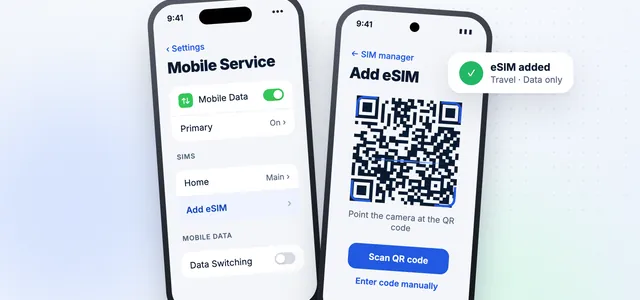
- Install it at home on Wi-Fi before you fly.
- When you land, switch the eSIM on, set it as your mobile data line and turn on data roaming for that line.
- Keep data roaming off on your home SIM.
Install before you land at CDG or Orly
Airport Wi-Fi can be busy and slow. Installing at home means you can check trains into Paris and message your hotel as soon as you land.
Our step-by-step guide shows how to install an eSIM on iPhone and Android.
Tips for Staying Connected in France
- Visiting Spain, Italy or Switzerland too? A Europe plan can cover the whole route with one eSIM; check the country list for Switzerland.
- Download offline maps for the countryside. Villages and mountain roads can have weak signal.
- Save tickets and reservations offline. Museum slots and train tickets are easier to show without waiting for signal.
- Keep your home number reachable. With a dual-SIM phone, your regular SIM can stay on for calls and texts while the eSIM handles data.
Frequently asked questions
Which network is best for an eSIM in France?
Orange, SFR, Bouygues Telecom and Free all cover the cities well. Orange is often described as having one of the most extensive networks, which helps in rural areas.
Does my eSIM work in the Paris Métro?
Mostly, yes. Most of the Métro has mobile coverage, though you may notice gaps in some tunnels.
Does a France eSIM work in Monaco?
Not necessarily. Monaco has its own network. Near the border you may pick up a French network, but check your plan if you'll spend time there.
Does a France plan cover Guadeloupe, Martinique or Réunion?
Usually not. The overseas departments are normally listed as separate destinations, so choose a plan for that destination.
Do I need an eSIM if I have an EU SIM card?
Maybe not. EU and EEA SIMs can usually roam in France at home rates, subject to fair-use limits.
Next step
See France eSIM plans
Compare plans by data, validity and price.
See France eSIM plansData Roaming Editorial Team
We write practical, plain-English guides about using your phone abroad. Roaming prices and rules change, so we update guides regularly — always confirm current terms with your carrier. About our editorial approach



 France
 Monaco
 Switzerland
 Europe
 USA eSIM
 Japan eSIM
 Spain eSIM
 Italy eSIM
 Dubai eSIM
 UK eSIM
 Turkey eSIM